2025 gave me the opportunity to spend an extended period in #India—something I had never experienced before, as my previous visits were typically limited to three weeks at most, often separated by gaps of five years or more. With time on our hands, my wife and I decided to plan a trip during November–December 2025, choosing the cooler months (though it still felt warm to us after living outside India for over two decades). We began the journey with a deep sense of joy—returning to our home country, reconnecting with loved ones, meeting cousins and parents, exploring places we had never visited before, and, of course, indulging in the food—especially the iconic #Vada Pav.
As part of our usual routine, after landing in #Mumbai and while en route to #Pune, we made a stop at a food mall to savor THE Vada Paav. A modest paav paired with an equally sized vada awaited us, accompanied by a tiny cup of chai-perhaps 20 ml, though I never bothered to measure it. Setting these idiosyncrasies aside, we happily enjoyed our very first Vada Pav upon landing in India.
Soon after, we found ourselves stuck in traffic in the ghat region. Roadwork-an ever-present reality-combined with a large number of erratically driven trucks to worsen the congestion. Smaller vehicles darting into every available gap only compounded the chaos, turning the slowdown into a full-blown traffic jam. India has changed significantly over the past few decades, largely for the better, and reminding myself of this helped me stay calm-also aided by the fact that I wasn’t the one driving. Eventually, our driver skillfully navigated us out of the mess, and we slowly made our way home, finally arriving around 2:00 a.m.
Arriving in India (in this case Mumbai airport) makes you quickly realize what you don’t have—your phone connectivity. How do you contact someone who’s come to pick you up, especially when it’s an unfamiliar driver? At the airport, there doesn’t seem to be a straightforward option to purchase a SIM card on the spot-at least none that I could find. One would happily consider opting for a temporary solution until you sort out your longer-term choice. In a digital-first world, the absence of something so basic leaves you feeling unexpectedly handicapped. And this is the case every time you land in India. Curbing the misuse of SIM cards also has a drawback…!
This post is dedicated to my observations/experiences good and bad while moving around within the state of Maharashtra (India’s richest and 3rd largest state in the Western region)
So, here’s my take and few observations that could very well be debatable, but of course these thoughts are completely mine and I can have my own opinion. So, let’s dive in.
Scenario 1: India have gone digital leaps and bounds.
The Good: All payments are expected to be via a phone through these and many such apps – GPay, UPI, PhonePay. No more or lesser cash transactions. Even small hawkers (bhaajiwala, vada paav wala, paan waala..) have a QR code for receiving payments. I have seen beggars too have one such QR code – you have no change doesn’t matter, pay us by your phone 🙂 – no more excuses. Amazing to see how deep this digitisation have penetrated. Not getting into the pros-and-cons of digitisation for the sake of keeping it simple.
The Bad: Every citizen is now forced to get a smart phone. Those who never carried one had to buy one, had to learn it or remain dependent on those who know. NRI/Foreigners can’t have this facility as these utilities need Aadhar Card (unique identity card given to every Indian citizen). UPI is only allowed by ICICI and HDFC banks for NRIs. For rest banking institutions you need a local phone number for which you need an Aadhar card and Aadhar card is not mandatory for NRIs.
The Ugly: Carry tons of cash and not everyone excepts it.
Scenario 2: BlinkIt
The Good: In India, you can get what you need—often what you want—within an average of 10 minutes. No exaggeration. Don’t believe it? You have to experience it firsthand. Swiggy and Zomato handle food deliveries, while BlinkIt delivers everything from bottled water to everyday household essentials.
Naturally, we decided to put this to the test. As my wife was about to take a shower, she realized there was no shampoo. I picked up my brother-in-law’s phone and placed an order for shampoo and conditioner—partly out of necessity, and partly to see if the hype was real. Before my wife even made it into the bathroom, the doorbell rang. There stood a BlinkIt delivery partner, bag in hand, with exactly what we had ordered.
We were genuinely stunned. The delivery took just 9.25 minutes. It’s an impressive service—especially valuable for the elderly or people with disabilities—showcasing how convenience has been redefined in today’s India.
Such a model can exist only in markets with a large consumer base willing to pay a premium to avoid everyday inconveniences, and where human resources are readily available. This ecosystem has also created meaningful employment opportunities for Indian youth, offering a constructive path for those who might otherwise remain idle or drift toward less positive directions.
The Bad: This facility is heavily used by the young generation. I have first had experienced this. This generation is so trigger happy that they don’t get up from their chairs or beds and order freely whatever comes to their mind. Laziness have seeped in.
There is also a significant risk borne by the delivery riders who bring these items to us within ten minutes. Their primary focus is meeting the delivery deadline, which can encourage erratic riding and unsafe behavior on already congested roads. This pressure increases the likelihood of altercations or accidents, raising important concerns about safety behind the promise of extreme convenience.
The Ugly: Laziness have encroached households. Obesity is slowly creeping.
Scenario 3: Infrastructure
The Good: India’s growth is unmistakable. Enter any city and you’ll see infrastructure projects everywhere, each reflecting the country’s momentum—driving employment, strengthening stability, building resilience, and enhancing connectivity.
The Bad: The sheer number of infrastructure projects underway brings with it an inevitable downside-more construction zones mean more dust, greater inconvenience, and added chaos on already strained roads. Surfaces deteriorate quickly, potholes appear overnight and often go unattended, and vehicle tyres wear out long before their expected lifespan. While many developed countries also undergo large-scale infrastructure upgrades, the experience for commuters and travelers is markedly different; disruptions there are typically better planned, clearly communicated, and managed in ways that minimize day-to-day hardship.
The contrast lies not in the absence of construction, but in execution and governance. Effective traffic management, temporary road quality standards, pedestrian safety measures, and accountability mechanisms help reduce inconvenience elsewhere. In India, the pace of development is commendable, but the lack of coordinated planning and consistent maintenance often shifts the burden of progress onto citizens. Growth, when not balanced with execution discipline, can quickly translate into avoidable discomfort.
This does not diminish the significance of the progress being made—it highlights the opportunity. With better planning, stricter oversight, and a citizen-first approach, India’s infrastructure growth can be both rapid and humane, delivering long-term benefits without imposing unnecessary short-term pain.
The Ugly: Anyone traveling through these areas is inevitably exposed to vehicle fumes and dust particles from all the road works, often spending long hours stuck in traffic. Over time, this constant exposure takes a toll on physical well-being, affecting overall health and quality of life.
Scenario 4: Civic Sense
The Good: Though the civic sense (traffic) is nonexistent – in most cases – Maharashtra has an organised chaos. People seem to support each other. They all seem to have a sixth sense. It’s okay to not signal your turn (left or right) as the vehicle behind knows what you are thinking and manages the nick. No one gets bothered or offended if they are not given their legitimate entry to the road they are turning into. Somehow, they all manage to drive through. Mumbai’s score of civic sense is better and a bit higher than Pune, I must say.
The Bad: A large number of riders appear indifferent to traffic rules. Only a small fraction of two-wheeler riders wear helmets, despite the mandate having been in place for many years. Zebra crossings are largely ignored, making one wonder why municipalities invest so much effort and paint in marking them when they carry little practical meaning. Pedestrian walk buttons are virtually nonexistent, leaving people to cross roads at their own risk.
While some areas do have underground subways and overbridges for pedestrians, they are rarely used. In many cases, underground passages have been encroached upon by drug users or drunkards, making commuters hesitant to use them; elsewhere, they are simply closed. Overbridges often require climbing long flights of stairs, and where lifts exist, they are either non-operational or vandalized.
Footpaths are often missing altogether. Where they do exist, they are rarely usable-frequently taken over by hawkers or, during traffic jams, used by two-wheelers as alternate driving lanes rather than spaces for pedestrians.
The Ugly: No one seems to care. And those who speak up are quietly pushed aside.
Note: In my previous blog I have briefly described the plight of traffic in Pune city. Read if not already.
Concluding with an apt picture which I recently took at one of the crossings in Kothrud, Pune.
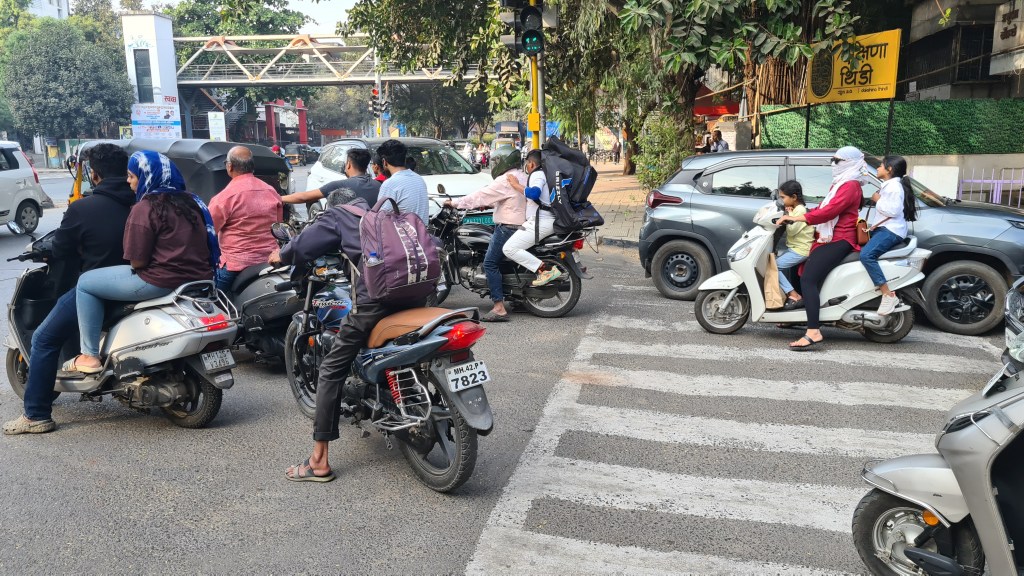
So, after highlighting quite a few shortcomings, it’s only fair to end on a positive-and slightly humorous-note. Despite the chaos, the contradictions, and the daily surprises, India (in this case Maharashtra) has an uncanny way of making things work. Somewhere between the traffic jams, missing footpaths, and ten-minute deliveries, life moves on with remarkable energy and optimism. You may complain, you may shake your head in disbelief, but before you know it, you’re smiling-often over a hot cup of chai or a freshly made Vada Pav-realizing that this beautiful madness is part of what makes India, India.
 Ranjit Tamhankar
Leave a comment